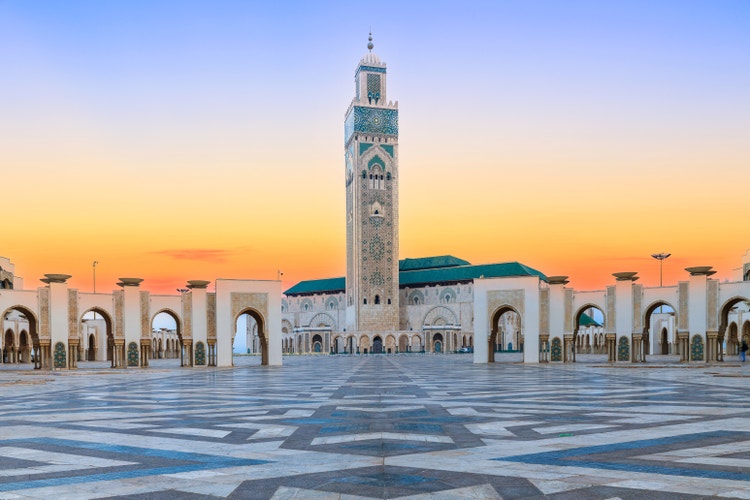
Hassan II Mosque in Casablanca, Morocco, with its courtyard and minaret at sunset.
Imperial Cities, Coastal Charms, and Living Traditions
Discover Morocco, where the Mediterranean meets the Atlantic and centuries-old traditions coexist with dynamic modern cities. Casablanca, the country's largest city, stretches along the Atlantic coast and is known for the Hassan II Mosque, its Art Deco heritage, and the souks of the Habous Quarter. Farther north, Tangier looks across the Strait of Gibraltar, with its whitewashed medina rising toward the Kasbah.
Beyond the coast, Morocco's imperial cities reveal layers of history. The Moroccan capital Rabat brings together royal landmarks and the blue-and-white Kasbah of the Udayas, while Marrakesh is defined by palace courtyards, historic Islamic architecture, and the lively souks around Jemaa el-Fnaa. In northern Morocco, Tetouan reflects a strong Andalusian heritage within its UNESCO-listed medina, and coastal Asilah adds a distinct artistic character with murals and galleries set within its old Portuguese walls.
Celestyal cruises to Morocco
Morocco cruise stop highlights
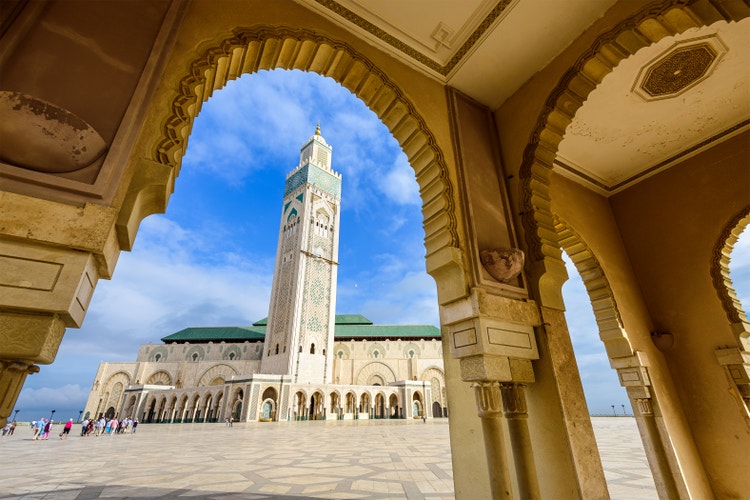
Hassan II Mosque in Casablanca, Morocco, framed by ornate arches under a blue sky.
Casablanca Architecture and Morocco’s Imperial Cities
Casablanca brings together some of Morocco's most distinctive architecture, from the oceanfront Hassan II Mosque, known for its intricate tilework and carved cedar, to the French-influenced and neo-Moorish buildings around Mohammed V Square.
From here, continue to two of Morocco's best-known imperial cities. Rabat, the capital city of Morocco, is home to the Hassan Tower, the Mausoleum of Mohammed V, and the fortified Kasbah of the Udayas. In Marrakesh, the 12th-century Koutoubia Mosque and its minaret rise above the medina, while Ben Youssef Medersa, a historic Islamic college, offers a closer look at Morocco's architectural and decorative traditions. Beyond, the medina's busy souks lead toward Jemaa el-Fnaa, where storytellers, musicians, and performers help animate the square.
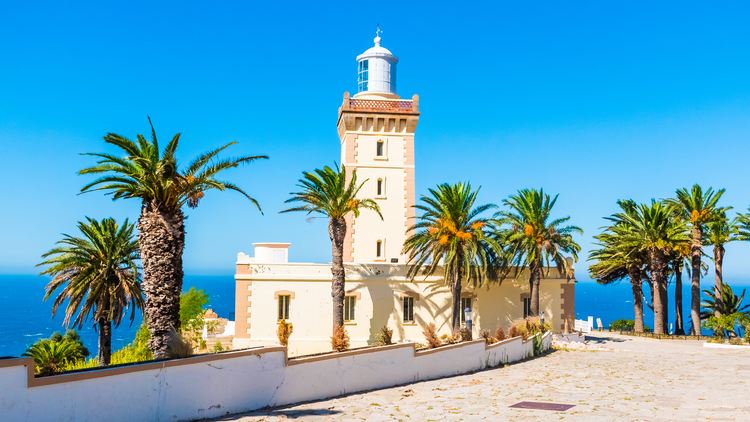
Cape Spartel lighthouse near Tangier, Morocco, surrounded by palm trees and overlooking the coast.
Tangier and Northern Morocco
At Morocco's northern edge, Tangier reflects both Mediterranean and Atlantic influences, with whitewashed houses, busy souks, and winding lanes through the medina. Follow the coast to Cape Spartel and the Caves of Hercules, or continue to Tetouan, where Andalusian heritage is evident in its UNESCO-listed medina and Hispano-Moorish architecture. Nearby Asilah offers a gentler coastal atmosphere, with galleries, ever-changing street murals, and Atlantic views framed by historic walls.
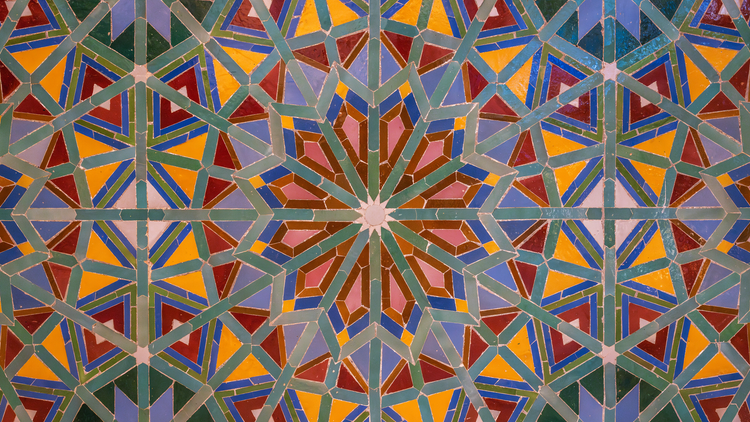
Colorful traditional Moroccan zellige tilework with intricate geometric patterns.
Moroccan Flavors and Living Traditions
Some of Morocco's most memorable experiences are rooted in traditions that remain part of everyday life. Discover the art of Arabic calligraphy and traditional embroidery, or pause for lunch in the peaceful courtyard of a riad. Food offers another window into local culture: taste tagine, a slow-cooked savory stew; enjoy warm bread baked in a communal oven; and sip refreshing mint tea. It’s all part of a long-standing tradition of hospitality centered on the table.