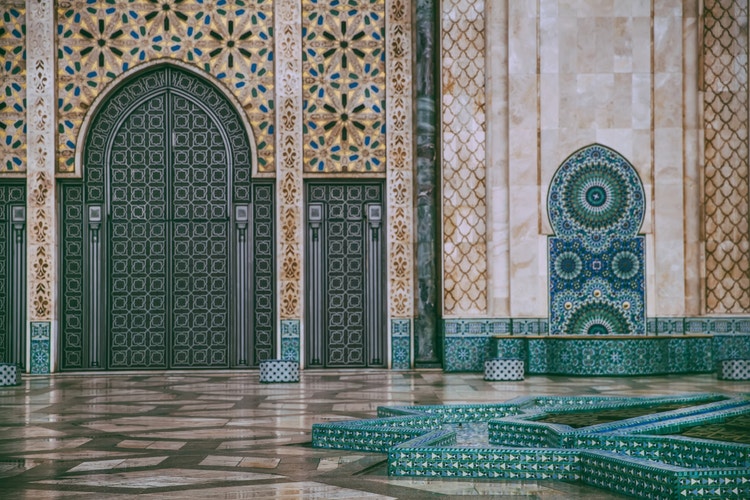
Ornate zellige tilework and decorative doors at Hassan II Mosque in Casablanca, Morocco.
Discover Casablanca and Morocco’s Imperial Cities
Explore Casablanca, Morocco’s largest city, where Atlantic breezes move through a vibrant metropolis of landmark architecture, broad boulevards, and historic quarters. At the ocean’s edge, the Hassan II Mosque rises on a monumental scale, its intricate tilework and carved cedar displaying the craftsmanship found throughout Morocco. Art Deco façades recall Casablanca’s rapid 20th-century growth, while the Habous Quarter, the city’s New Medina, draws on older Moroccan traditions through its arcades, artisan souks, and traditional architecture.
Casablanca is also your gateway to two of Morocco’s fascinating imperial cities. North lies the capital of Rabat, with its royal monuments and blue-and-white Kasbah of the Udayas. South, Marrakesh brings together palace courtyards, historic Islamic architecture, busy Medina souks and the evening energy of Jemaa el-Fnaa.
Celestyal Cruises to Casablanca
Casablanca cruise port highlights
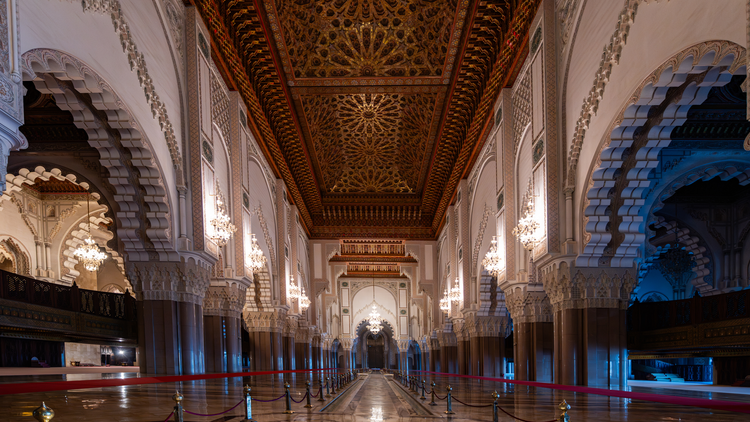
Ornate interior of the Hassan II Mosque in Casablanca, with carved arches and a richly decorated wooden ceiling.
Hassan II Mosque and Casablanca’s Architectural Heart
Set at the Atlantic’s edge, the Hassan II Mosque is Casablanca’s signature landmark and a remarkable expression of Moroccan craftsmanship. Built partly over the ocean, it appears to rise directly from the water, with its soaring minaret dominating the city's skyline. Inside, the vast prayer hall can accommodate around 25,000 worshippers beneath a retractable roof that opens to the sky. The closer you look, the more there is to admire, from marble and intricate tilework to hand-carved cedar ceilings.
Casablanca’s architectural story continues at Mohammed V Square, known as Pigeons’ Square, where colonial French and Moorish-inspired buildings surround the central fountain. Nearby streets are lined with elegant Art Deco façades. Along the Atlantic, the Corniche gives Casablanca a very different setting, with the ocean running beside one of the city’s best-known coastal boulevards. Casablanca’s boulevards and waterfront have also become familiar territory for international filmmakers, with locations around the Corniche and Boulevard Mohammed V appearing in major action productions.
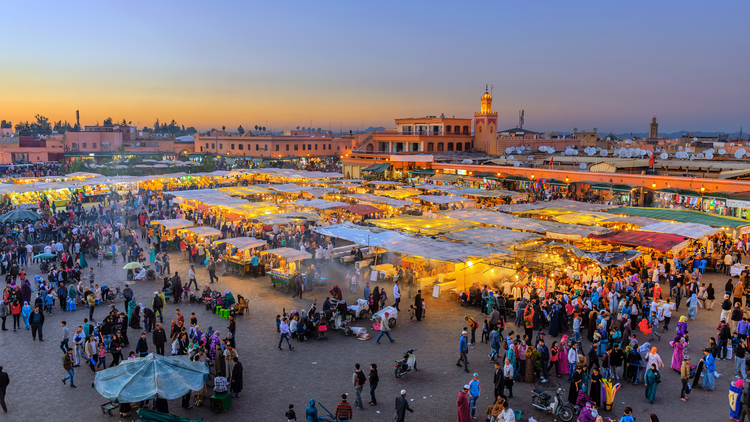
Jemaa el-Fnaa square in Marrakech, Morocco, filled with market stalls and visitors at dusk.
Rabat and Marrakesh, Morocco’s Imperial Cities
Journey north from Casablanca to Rabat, where royal monuments and Atlantic scenery give Morocco’s capital its elegant character. The unfinished Hassan Tower rises above rows of stone columns belonging to an ambitious 12th-century mosque that was never completed. Nearby, the Mausoleum of Mohammed V stands out for its richly decorated interior. Continue to the historic Kasbah of the Udayas, a blue-and-white fortified quarter overlooking the Atlantic.
South of Casablanca, Marrakesh brings a different scale of color and activity. The 12th-century minaret of the Koutoubia Mosque rises above the rooftops, while the richly decorated Dar El Bacha offers a closer look at refined Moroccan craftsmanship. At Ben Youssef Medersa—a historic Islamic school—carved cedarwood and colorful zellige tiles surround a peaceful courtyard. Beyond lies the Medina, where a maze of souks and artisan workshops leads toward Jemaa el-Fnaa. By late afternoon, Jemaa el-Fnaa fills with musicians, storytellers, and performers, turning the square into one of Marrakesh’s most memorable scenes.
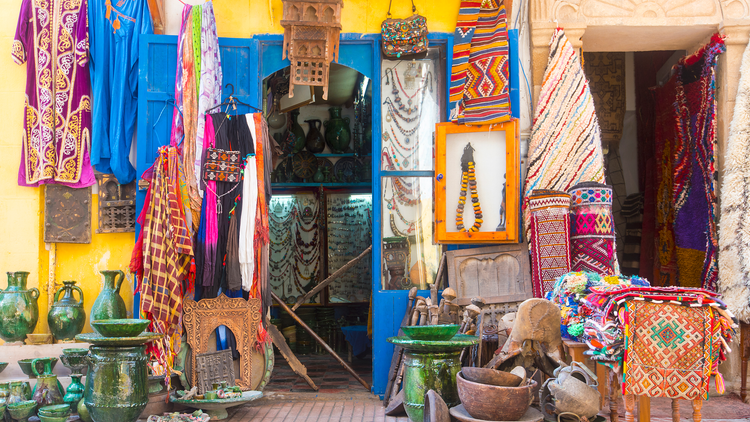
Colorful Moroccan textiles, ceramics and handcrafted goods displayed in an artisan shop.
Habous Quarter, Moroccan Art and Calligraphy
The Habous Quarter may be Casablanca’s New Medina, but its stone arcades, traditional bakeries, and artisan shops draw strongly on older Moroccan traditions. Narrow streets open onto small squares filled with locally made goods, creating a quieter atmosphere than the busy city center and a place made for unhurried exploration.
Casablanca’s artistic side comes into sharper focus at the Abderrahman Slaoui Museum. Housed in a 1940s residence, its collection ranges from vintage Moroccan posters and jewelry to paintings, ceramics, and decorative objects gathered by the collector whose name it bears.
The city’s artistic traditions are also something you can see being practiced. Arabic calligraphy takes shape under the guidance of a local master, accompanied by Moroccan mint tea, while a textile workshop introduces the techniques behind traditional Moroccan embroidery.
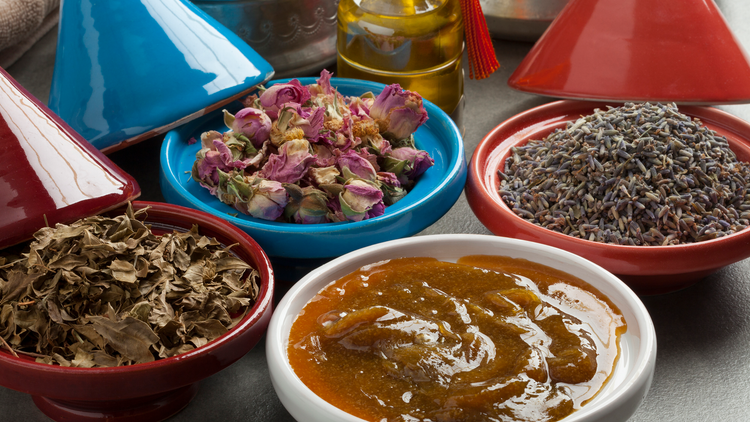
Moroccan hammam ingredients in colorful bowls.
Riad Dining and Moroccan Hammam Traditions
Some Moroccan traditions are best understood away from Casablanca’s great monuments. Inside a traditional riad, lunch is served around an elegant inner courtyard, a quiet, private space that brings the warmth and intimacy of Moroccan hospitality to the table.
The hammam offers another unique experience, based on a centuries-old bathing ritual that uses heat, water, and body care for relaxation and renewal. More than just a place for bathing and cleansing, the hammam has long been a social gathering spot, with rituals centered on steam and exfoliation that are still important in Moroccan culture today.