Couple looking at a map with a sunset and outlines of Istanbul architecture silhoutted behind them
Crossroads of Cultures
Few cities represent as ravishing a meeting of substance and spectacle as Istanbul, a grand and sprawling capital that ranks among the world’s truly great cities. Here are grand mosques and churches, palaces and bazaars, museums and sites of unsurpassed natural beauty and of course the legendary Bosphorus, flowing from the Black Sea past the Golden Horn and the heart of the city to the Sea of Marmara.
The European part of Turkey straddles the western banks of the narrow strait, and Asia starts on the eastern shore, making Istanbul the world’s only city built on two continents. In the sixth century BC, Byzantium was a colony of the ancient Greek city of Megara, and only much later did Constantine the Great move the seat of the Roman Empire here. For more than a millennium and a half, this timeless metropolis was the capital of empires. Today, the convergence of cultures and multi-religious coexistence here is truly extraordinary. In Istanbul, traditions from not only Islamic but also Christian and Jewish faiths rub shoulders easily with the vibrant mosaic that is contemporary Turkey.
Celestyal Cruises to Istanbul
Top highlights of Istanbul
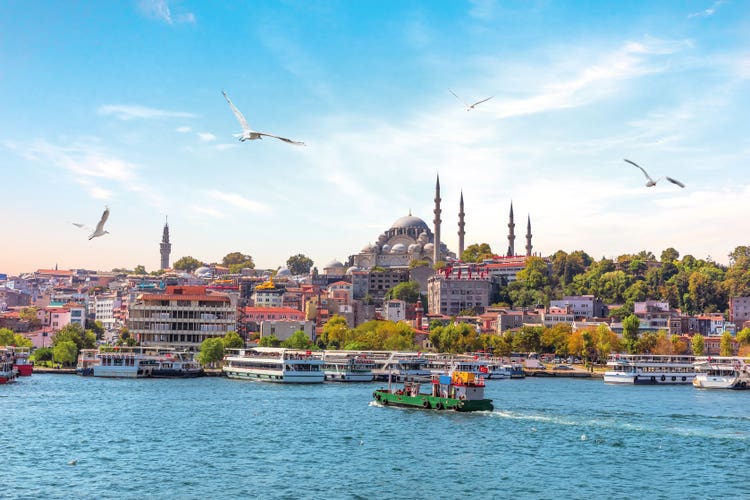
A view of the Golden Horn from the sea, an inlet of the Bosphorus
Bosphorus and the Golden Horn
Of this majestic imperial city, whose historical areas were listed as a UNESCO World Heritage site in 1985, the legendary British writer Jan Morris wrote that “In all European travel there is no spectacle more tremendous than the sight of Istanbul massed beside the sea.”
The Golden Horn, an inlet of the Bosphorus, flows between the commercial center of Karaköy and Sarayburnu, or the Old Seraglio Point promontory that’s home to the Topkapi Palace, Sultanahmet Square, and many important monuments. Opposite the Golden Horn and adjacent to Karaköy is the old district of Pera, settled by the Genoese and Venetians in the 12th century and home of the iconic Galata Tower. The ornate Dolmabahçe Palace, formerly the Sultan’s palace and now a museum, is on the European side of the Bosphorus, in a historic area of mansions and elegant yali, or waterfront wooden villas. A boat excursion along the Bosphorus is a great way to experience this visual pageantry. The Boğaziçi Bridge looms over the neo-Baroque style Ortaköy Mosque and spans more than 5,000 feet across the Bosphorus.
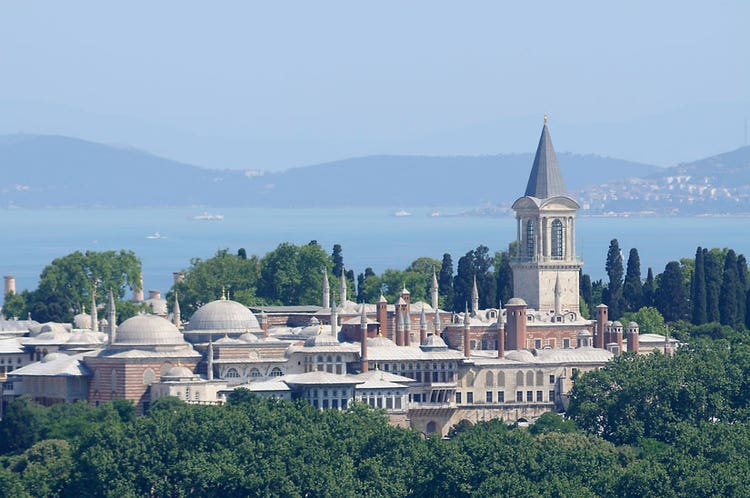
Aerial view of Topkapi palace with the sea in the background
Topkapi Palace
Topkapi, on the strategic Seraglio point, is the definitive Ottoman Turkish palace. Its construction started in the 1460s by the order of Sultan Mehmed II, and it’s where the Sultans held court. The palace houses the Mgbaddes Emanetler Dairesi (Chamber of Holy Relics) where the Prophet Muhammed’s Hırka-i Saadet (Blessed Mantle) and Sancak-ı Şerif (Holy Banner) are kept in their golden chests.
Other treasures include the jewels of the Sultans, ornate swords, chalices set with precious stones, the emerald-encrusted Topkapi Dagger, and a throne encrusted with 18,000 pearls. The palace also housed Janissary quarters for the elite Ottoman troops and some 400 rooms that were part of the famous Imperial Harem. Topkapi’s gardens afford panoramic views of the legendary waters of the Bosphorus and Sea of Marmara.
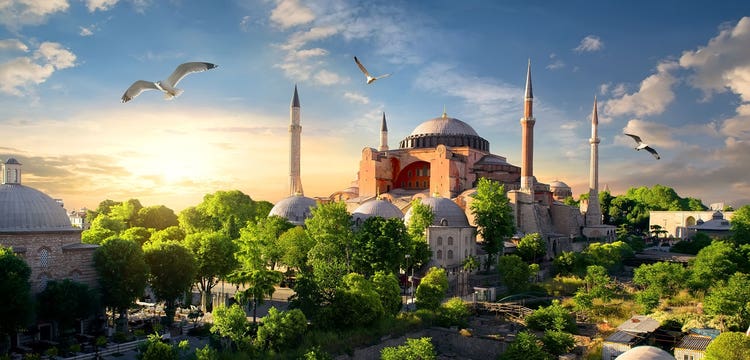
Gulls flying around Hagia Sophia Grand
Hagia Sophia and Basilica Cistern
Constantine, the first Christian Emperor of Rome, ordered Saint Sophia to be built in 347AD as an imperial church, and with 50 tons of gold, multicolored marble, and upwards of 170 pillars from other temples (including those in Athens and Ephesus), it opened 16 years later—only to be twice destroyed by fire before Justinian the Great rebuilt it in 552. For more than a thousand years, it was the center of Eastern Orthodox Christianity, before Mehmet the Conqueror had the huge structure with its signature colossal dome converted to a mosque in 1453. In 1935, the Hagia Sophia was converted yet again, this time to a museum, and many of the original Byzantine mosaics, such as the one depicting the Virgin Mary with the baby Jesus and Constantine and Justinian standing on either side, have been faithfully restored.
The cathedral-sized Basilica Cistern is an elaborate underground network of cisterns built by some 7,000 slaves during the Early Roman period to supply water to the Great Palace (and later to Topkapi Palace). Its spectacular array of vaulted roofs and floodlit columns lie less than 500 feet southwest of the Hagia Sophia.
Gulls flying around Hagia Sophia Grand
Hagia Sophia and Basilica Cistern
Constantine, the first Christian Emperor of Rome, ordered Saint Sophia to be built in 347AD as an imperial church, and with 50 tons of gold, multicolored marble, and upwards of 170 pillars from other temples (including those in Athens and Ephesus), it opened 16 years later—only to be twice destroyed by fire before Justinian the Great rebuilt it in 552. For more than a thousand years, it was the center of Eastern Orthodox Christianity, before Mehmet the Conqueror had the huge structure with its signature colossal dome converted to a mosque in 1453. In 1935, the Hagia Sophia was converted yet again, this time to a museum, and many of the original Byzantine mosaics, such as the one depicting the Virgin Mary with the baby Jesus and Constantine and Justinian standing on either side, have been faithfully restored.
The cathedral-sized Basilica Cistern is an elaborate underground network of cisterns built by some 7,000 slaves during the Early Roman period to supply water to the Great Palace (and later to Topkapi Palace). Its spectacular array of vaulted roofs and floodlit columns lie less than 500 feet southwest of the Hagia Sophia.
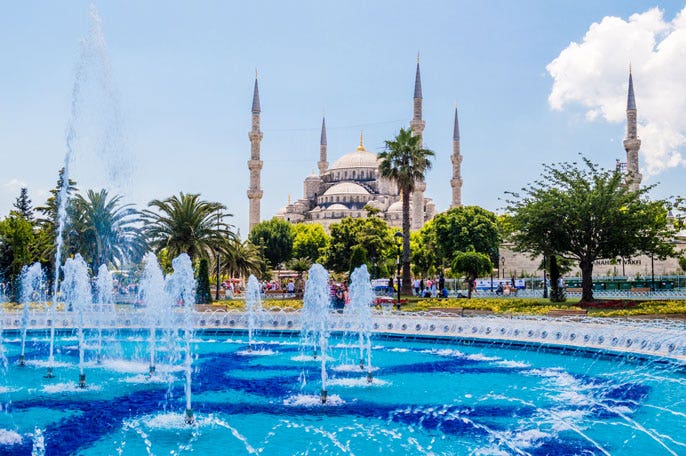
Gulls flying around Hagia Sophia Grand
Sultanahmet Square and Blue Mosque
The square is the heart of Istanbul’s most historic peninsula, and some of the finest examples of Byzantine and Ottoman architecture are located here, including the famous Sultan Ahmet Mosque or Blue Mosque. Completed in 1616 and the world’s only mosque with six minarets, it has no fewer than 138 windows and takes its name from the beautiful, blue-colored tiles that line its interior. It also houses the tomb of its founder, Sultan Ahmed. Near the Blue Mosque, you can see the Obelisk of Theodosius and the ancient bronze Serpentine Column, which is on the site of the Hippodrome, the ancient “circus” or sporting center of Constantinople. The Arasta Çarşısı, or Arasta Bazaar, is located just behind the mosque and is a great stop for some unique handicrafts shopping.
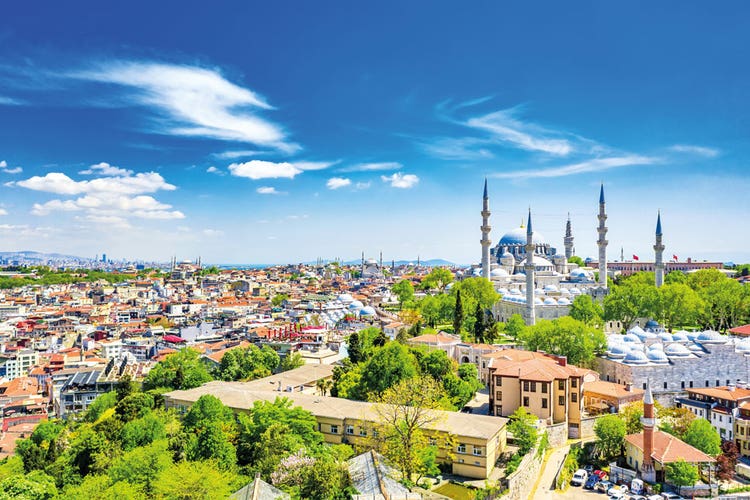
Aerial view of the Süleymaniye Mosque
Süleymaniye Mosque
Imperial Ottoman architect Mimar Sinan put his stamp on the Istanbul cityscape by building more than 300 structures during the reign of three sultans, including Suleiman the Magnificent, who commissioned the Süleymaniye Mosque in 1550. Sinan completed it seven years later, and the mosque’s main dome, several smaller domes, four soaring minarets, and graceful interior make it one of the most impressive religious sites in Istanbul. The mosque is located on the Third Hill of Istanbul, west of Sultanahmet Square but still within the city’s ancient walls.
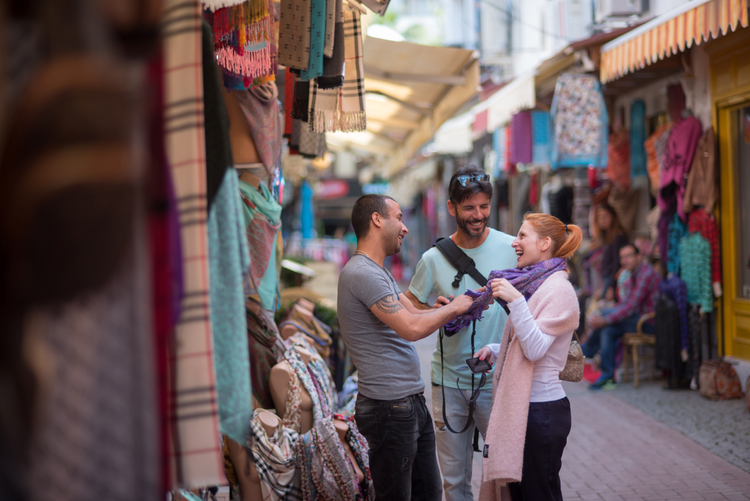
Colorful stalls and lively atmosphere at the Grand Bazaar in Kuşadası, Turkey, offering local crafts and souvenirs on Eastern Mediterranean cruise visits.
Grand Bazaar and Spice Bazaar
Istanbul’s Grand Bazaar, the Kapalı Çarşı, dates to 1461 and, along with the Spice Bazaar, is one of the most exciting stops you’ll make in the city. Originally, Sultan Mehmet the Conqueror set up the covered bazaar to generate income for the upkeep of the Hagia Sophia, and it was an important place for trade in Ottoman times. Today you will find everything from antiques to jewelry, gold to affordable souvenirs, and unique mementos in more than 3,000 individual shops.
Similarly, the Spice Bazaar (also called Mısır Çarşısı or Egyptian Bazaar) was built in 1660 to support the New Mosque. There are nearly 100 shops selling not only spices and dried fruits and nuts but also jewelry, souvenirs, and, of course, the famous Turkish delight and other traditional sweets. The bazaars are sensory feasts and one of the most essential and authentic experiences of Istanbul.