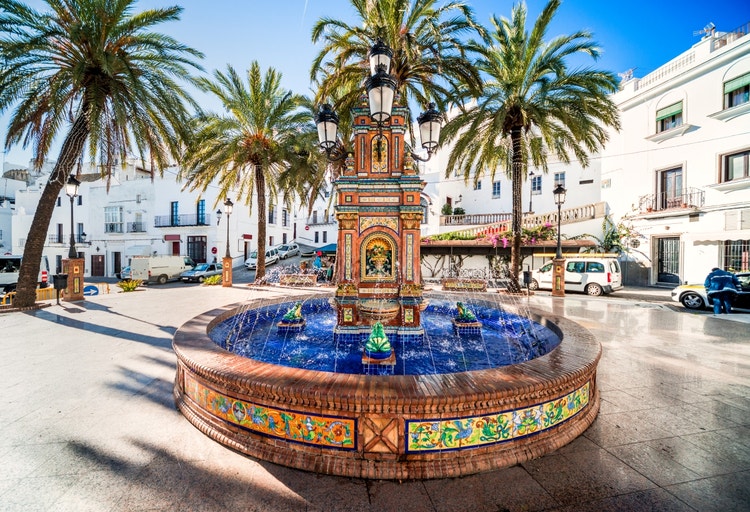
A fountain in Plaza del espana - Vejer de la Frontera - white village in Andalusia, near Cádiz in Spain
Uncover Cádiz and the Spirit of Andalusia
Venture beyond Cádiz and the landscape begins to change, with white villages appearing among the hills of Andalusia. In Jerez de la Frontera, sherry-making, flamenco, and the famous Carthusian horses are part of daily life. Seville, further inland, is the heart of Andalusia, known for its grand Cathedral and the cobbled streets and white houses of the Santa Cruz quarter.
During Christmas, this region of the Mediterraneanis especially inviting. Nativity scenes fill Cádiz, holiday decorations brighten the streets of Vejer, and in Seville, decorated balconies and seasonal treats make the celebrations feel warm and welcoming. holiday decorations brighten the streets of Vejer, and in Seville, decorated balconies and seasonal treats make the celebrations feel warm and welcoming.
Celestyal Cruises to Cádiz
Cádiz cruise port highlights
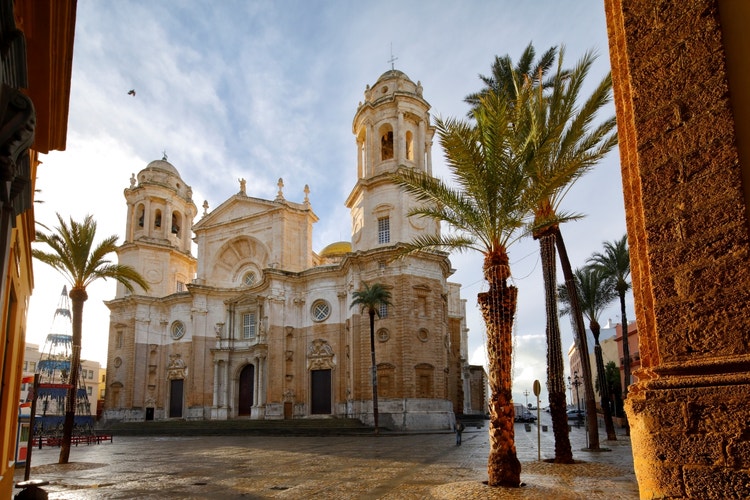
Plaza de la Catedral (Cathedral Square) in Cádiz, Spain
Cádiz Old City and Atlantic Fortresses
Near the old Cathedral of Cádiz, the Roman Theater is woven into the surrounding streets, a reminder of just how far back the city’s story reaches. Not far away, Plaza de España marks another defining moment in Cádiz’s history with its monument to the Constitution of 1812. Nearby, Calle Ancha is lined with elegant historic buildings, with lively plazas adding to the character of the old city. Then the streets open toward the Atlantic. La Caleta beach lies between two historic fortresses, Santa Catalina on the shore and San Sebastián just offshore, creating a striking contrast with the close-set streets of the old quarter.
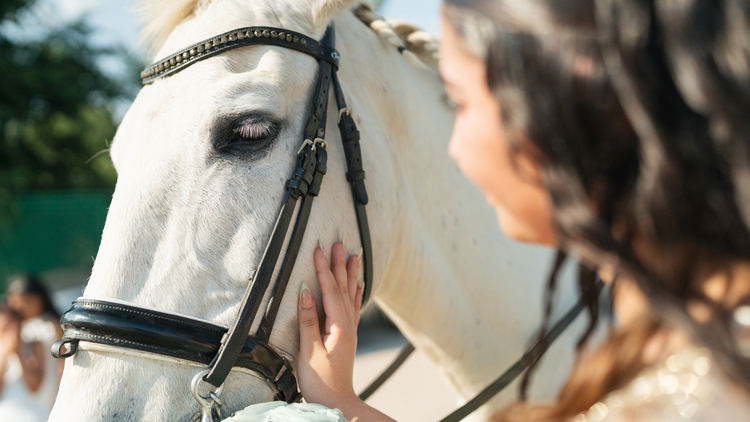
A photograph of a white purebred Carthusian Spanish Horse in harness being stroked by a woman near the port of Cádiz
Jerez, Sherry, Flamenco, and Carthusian Horses
Founded in 1730, Bodegas Fundador is the oldest winery in Jerez. Inside, its 18th- and 19th-century cellars and courtyards create what feels like a small city devoted to sherry and brandy. Three styles of brandy—Brandy Solera, Solera Reserva, and Solera Gran Reserva—are paired with carefully selected chocolates. That sense of tradition continues with flamenco. At the historic Tabanco El Pasaje bar, the intimate setting brings you close to live music and dance, accompanied by traditional tapas and an introduction to the cultural importance of flamenco in Andalusia.
At Yeguada La Cartuja, more than 300 Carthusian horses live on an estate dedicated to preserving one of the oldest and purest bloodlines of the Pure Spanish Horse. Their daily training offers a closer look at the care behind a lineage connected with Jerez’s Carthusian monastery since the 15th century.
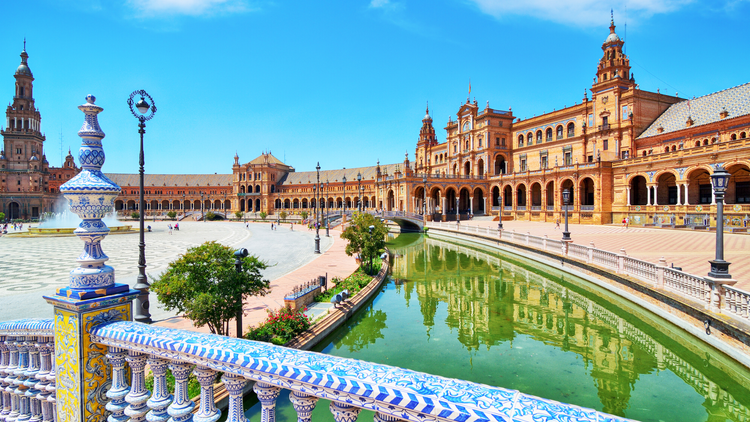
A panoramic shot of the historic city of Seville. The photo is taken from a bridge of magnificent sandstone coloured buildings with ornate finishings and arches. The buildings follow the curve of a freshwater canal that is visible in the foreground to background of the photo and curves to the left with other bridges visible in the distance to cross it.
Seville and the Heart of Andalusia
Seville is one of Andalusia’s great historic cities, with its vast Cathedral rising over the center on the site of a mosque dating from the late 12th century. Inside, the soaring Gothic space reflects the scale and ambition of the city at its height, while nearby Santa Cruz tells a more intimate story. Once Seville’s Jewish quarter, its narrow-cobbled lanes pass between whitewashed houses and open onto small squares, where shaded corners and tapas bars keep the neighborhood lively throughout the day.
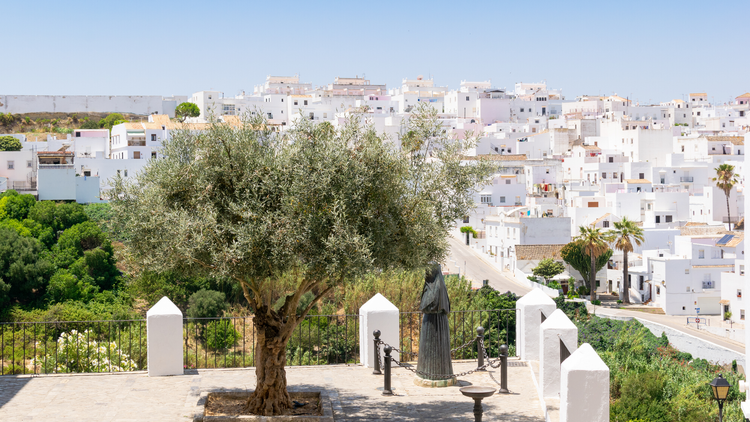
A view of a large olive tree and a statue in a park with a multitude of whitewashed houses in the background found in the countryside of Andalusia.
Andalusian White Villages and Cape Trafalgar
Beyond Cádiz, the celebrated Pueblos Blancos begin to appear among the rolling Andalusian hills. Vejer de la Frontera rises above the countryside in a cluster of whitewashed houses and narrow cobbled lanes, with traces of its Moorish heritage still visible throughout the hilltop town. Its old streets and elevated setting offer sweeping views across the surrounding countryside toward the Atlantic.
Along the Costa de la Luz—the “Coast of Light”—the hills give way to a broad stretch of open coastline. Cape Trafalgar stands within this windswept landscape, forever associated with the famous naval battle of 1805. Not far away, you’ll find Conil de la Frontera, a laid-back town where whitewashed houses and narrow streets spill toward the coast, expressing the easygoing spirit of Andalusia.