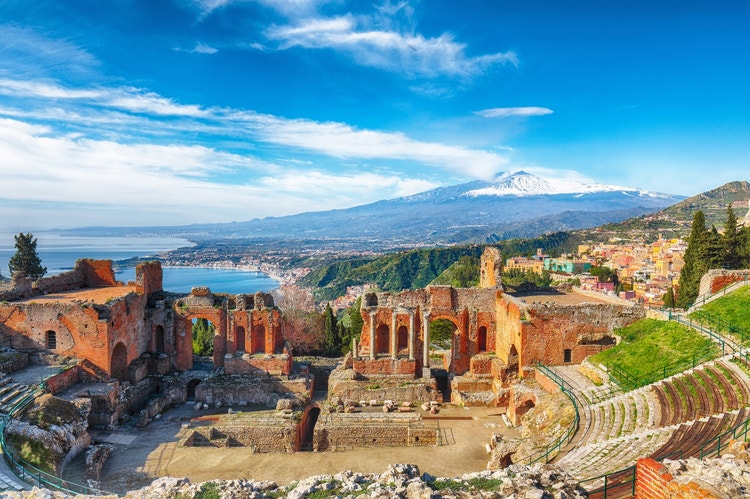
Ancient Greek theater ruins in Taormina, Sicily, overlooking the coast and Mount Etna.
Gateway to Mount Etna and Eastern Sicily
Messina occupies a remarkable position at Sicily’s northeastern tip, looking across the narrow strait toward mainland Italy and standing at the gateway to an island with centuries of history behind it. The city itself has had to begin again more than once. Earthquakes, war, and centuries of changing rule have altered its appearance, yet at its heart stands the reconstructed Norman Cathedral, a reminder of just how much Messina has endured and rebuilt. Its waterfront looks across the Strait of Messina, while beyond the city the mountains and villages of eastern Sicily quickly take over.
Beyond Messina, Mount Etna soon fills the horizon. Its dark lava fields and volcanic craters give way lower down to fertile winemaking country. Along the Ionian coast, Taormina sits high above the sea with its ancient theater, while the medieval villages of Savoca and Forza d’Agrò found a different kind of fame on the big screen through The Godfather films. With a Celestyal cruise to Messina, you can explore Etna’s volcanic terrain, taste Sicilian wines and local specialties, or follow winding village streets into a Sicily that feels far removed from the rush of modern life.
Celestyal Cruises to Messina
Messina cruise port highlights
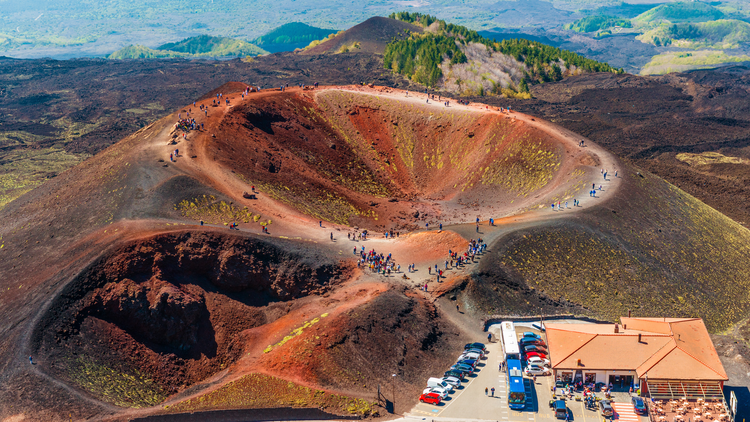
Silvestri Craters on Mount Etna in Sicily, with visitors walking through the volcanic landscape.
Mount Etna and Sicily’s Volcanic Vineyards
There’s no mistaking Mount Etna once it begins to fill the horizon. Europe’s great active volcano rises above eastern Sicily in a landscape of cones, craters, and old lava flows, with the terrain becoming increasingly bare as you climb. At around 1,950 meters (about 1.21 mi) above sea level, the Silvestri Craters bring you onto the volcanic landscape itself. Black lava marks more recent eruptions; older flows have faded to gray, and from the crater area the view reaches toward the Gulf of Catania. Etna’s long record of eruptions has been documented for at least 2,700 years.
Etna’s volcanic slopes are also home to some of Sicily’s most distinctive vineyards. Vines push through dark soils formed from old lava and ash, and native grapes such as Nerello Mascalese and Carricante have adapted particularly well to these high-altitude conditions. The wines can be enjoyed alongside small Sicilian specialties, offering a taste of a landscape closely shaped by the mountain itself.
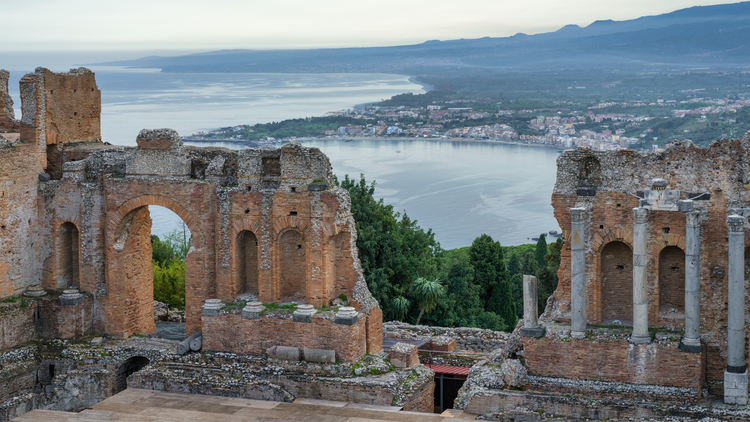
Ancient Greek theater ruins in Taormina overlooking the Ionian Sea and Sicilian coastline.
Taormina Above the Ionian Sea
Perched high above the coast, the town of Taormina has drawn visitors for generations. Its ancient theater began as a Greek performance space and was later transformed under Roman rule. Its stone tiers frame Mount Etna and the Ionian Sea in one of Sicily’s most memorable views, with the town’s elevated position adding to the sense of spectacle.
Nearby, Palazzo Corvaja brings another period of Taormina’s history into focus. Its oldest section is an Arab tower dating from the period of Muslim rule in Sicily, later incorporated into the medieval palace. Gothic mullioned windows overlook the inner courtyard, while a 15th-century hall once hosted meetings of the Sicilian Parliament. Arab, Norman, and Gothic elements can be seen throughout the building, documenting centuries of change within a single palace
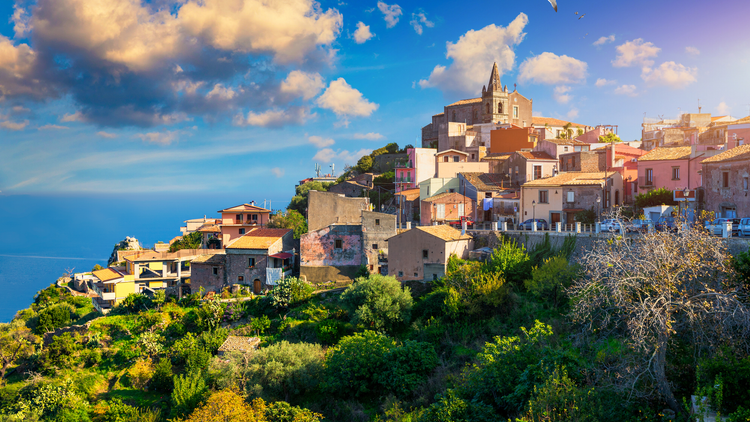
Hilltop village of Savoca in Sicily, with colorful houses overlooking the Ionian Sea.
The Godfather Villages of Sicily
In the hills south of Messina, Savoca and Forza d’Agrò found a second life on the big screen as filming locations for The Godfather movies. Savoca’s medieval streets lead past old stone buildings to Bar Vitelli, one of the film’s best-known locations, while the ruins of the town’s medieval castle sit higher on the slope.
Nearby Forza d’Agrò is another hilltop village overlooking the Ionian Sea. Here, a 16th-century castle crowns the rock above the village, and the Church of the Annunciation will be familiar to fans of The Godfather Part II. Beyond their cinematic connections, both villages offer old stone streets, medieval landmarks, and wide views across the Sicilian countryside.