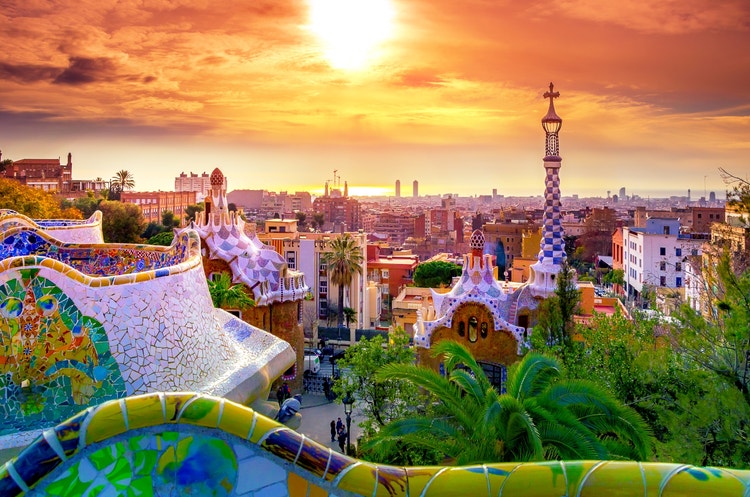
Rooftop view of the city of Barcelona from the Gaudi museum, Barcelona, Spain
Experience the Best of Tarragona and Barcelona
Known to the Romans as Tarraco, Tarragona was one of the great cities of Roman Hispania more than 2,000 years ago, its Mediterranean position helping it grow into an important center of trade and power. That Roman legacy is still visible throughout this city on the coast of Catalonia. Beside the sea, the Roman Amphitheatre recalls the gladiators and public spectacles that once drew crowds, while the remarkably preserved Roman Circus tells of another favorite form of entertainment in ancient Tarraco: chariot racing. Today, ancient remains sit among old streets, Mediterranean views and the everyday life of a lively Catalan city. and the everyday life of a lively Catalan city.
Barcelona brings a very different expression of Catalonia. Gaudí’s imagination seems to have rewritten the rules of architecture here, from the iconic Sagrada Família to Casa Batlló, Casa Milà and the colorful Casa Vicens. The winding lanes of the Gothic Quarter offer another side of the city, and Barcelona’s creative streak reaches the table too, from tapas in Ciutat Vella to theatrical contemporary Catalan dining. From Tarragona’s Roman monuments to Barcelona’s Modernist architecture, there is an extraordinary range of Catalan history and culture within reach of your cruise ship.
Cruises to Barcelona (Tarragona)
Top highlights of Barcelona
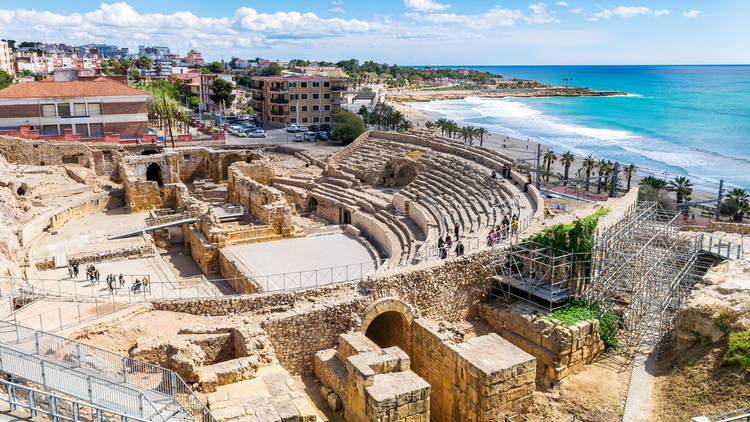
Aerial view of the an ancient Roman amphitheatre in Tarragona near the National Archaeological Center, near Barcelona Spain
The Living Legacy of Ancient Tarraco
Across Tarragona, the Roman legacy is hard to miss. Beside the blue waters of the Mediterranean, the Roman Amphitheater recalls the gladiators and public spectacles that once drew crowds here. Nearby, the remarkably well-preserved Roman Circus takes you into another part of daily life in ancient Tarraco, when chariot racing was one of the city’s great forms of entertainment.
At the National Archaeological Museum of Tarragona, the scale of Roman history comes down to more personal details. Intricate mosaics and imperial statues sit alongside everyday objects that show how people lived thousands of years ago.
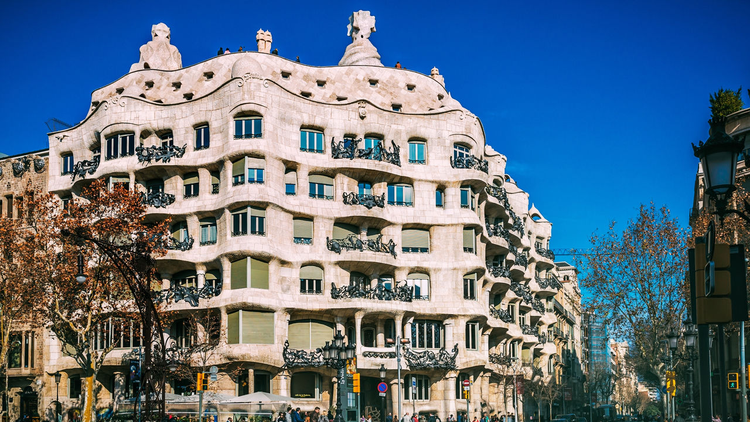
Casa Milà, also known as La Pedrera, with its distinctive curved stone façade in Barcelona.
Barcelona, the City of Gaudí
Few architects have influenced the appearance of a city as profoundly as Antoni Gaudí did Barcelona. His buildings each have their own personality, yet the flowing shapes, vivid ceramics and forms inspired by nature make his imagination instantly recognizable across the city.
At the Sagrada Família, Neo-Gothic foundations meet the flowing, organic forms of Catalan Modernism. The Nativity and Passion façades are covered in extraordinary detail, while inside, columns rise like trees beneath stained-glass light. At Casa Batlló, Gaudí’s imagination takes a more playful turn, with marine-inspired details and a roof often compared to the back of a dragon. Nearby, Casa Milà, better known as La Pedrera, takes experimentation even further through its undulating stone exterior and innovative engineering.
Casa Vicens goes back to the beginning of Gaudí’s architectural career. His first residential commission is filled with bright ceramic tiles, Moorish influences and bold patterns that hint at ideas he would develop throughout his life. La Pedrera changes again after dark, when projection mapping uses the sculptural chimneys of its Warrior Rooftop to tell the story of Gaudí’s inspirations, accompanied by music.
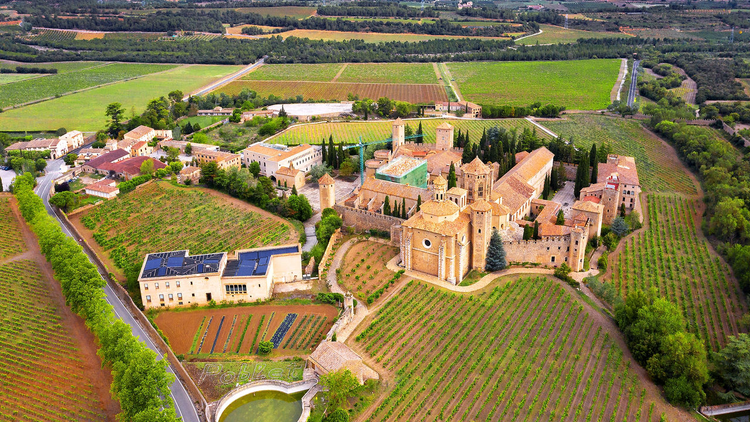
Aerial view of Poblet Monastery surrounded by vineyards and countryside in Catalonia, Spain.
The Quiet Grandeur of Poblet Monastery
At the foot of the Prades Mountains, the Royal Monastery of Santa Maria de Poblet has stood among the Catalan countryside for more than eight centuries. This UNESCO World Heritage Site grew into an important center of faith and culture, protected by fortified walls that still enclose its Gothic arches and peaceful cloisters. The royal tombs of Aragonese kings lie here too, their carved marble monuments recalling Poblet’s close connection with the Crown of Aragon. A small community of Cistercian monks still lives within the monastery, continuing a religious tradition that has defined the site for centuries.
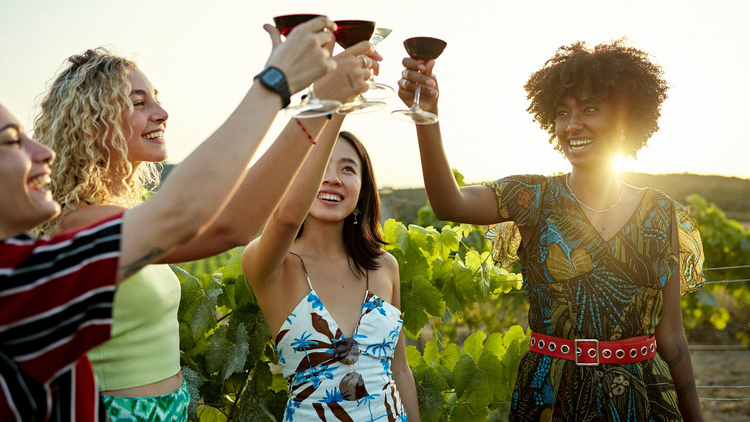
Friends raising glasses of wine in a vineyard in Catalonia, Spain.
Nulles and Its Modernist Wine Cathedral
In rural Catalonia, Nulles is surrounded by 80-year-old vines and traditional dry-stone walls, with winemaking still closely tied to the surrounding landscape. Local reds and whites are paired with toasted hazelnuts and rustic bread drizzled with extra-virgin olive oil, before a glass of Adernats cava brings another of the region’s wine traditions to the table.
The village is also home to the Adernats cooperative winery, one of Catalonia’s original Modernist “Wine Cathedrals.” Designed in 1919 by Cèsar Martinell, a student of Antoni Gaudí, its soaring brick arches turn a working winery into a remarkable piece of agricultural architecture. More than a century later, wines and cavas are still produced here under the DO Tarragona and DO Cava designations.
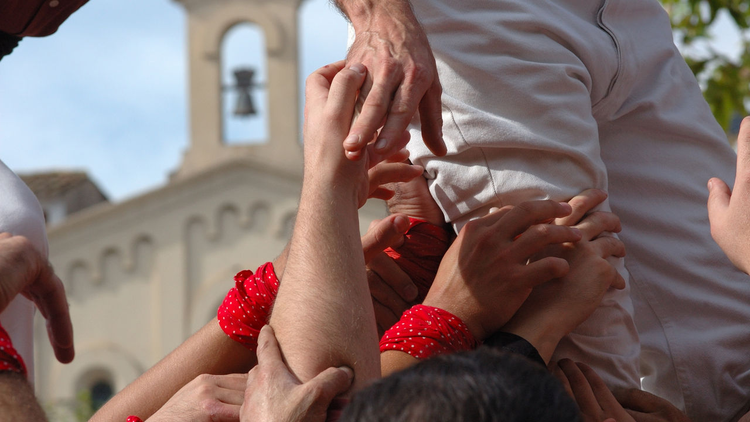
Hands supporting a member of a Catalan human tower, or castell, during the traditional gathering in Valls, Spain.
Valls and the Spirit of the Castells
In the Catalan town of Valls, castells bring people together in one of the region’s most remarkable living traditions. Built layer by layer by teams known as colles castelleres, these human towers depend on strength, teamwork and extraordinary coordination. Recognized by UNESCO as Intangible Cultural Heritage of Humanity, they remain a powerful expression of Catalan community life.
At the Museu Casteller de Catalunya, interactive displays and multimedia exhibits explain the history and technique behind the tradition. Enxaneta 360 goes a step further, using virtual reality and 360-degree footage recorded during a live gathering to recreate the sensation of standing inside the pinya, the tightly packed base supporting the tower. It puts you unusually close to the concentration and collective effort required to make a castell rise.