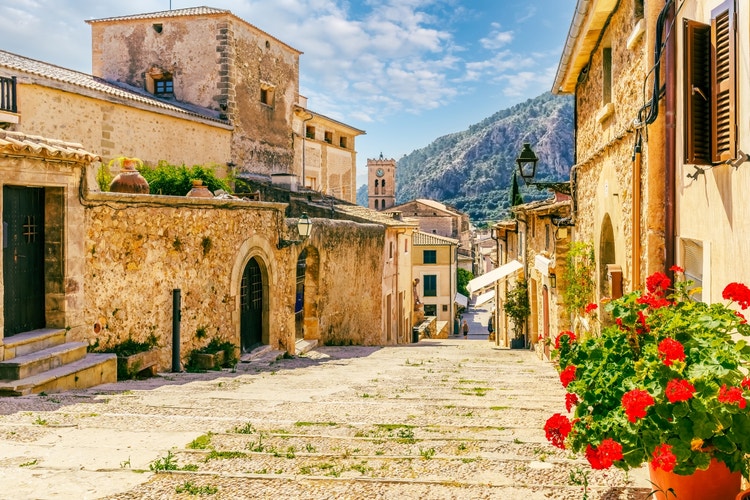
Sloping stone streets in Palma's Old Town, Palma de Mallorca Spain
Gothic Beauty and Island Traditions
Palma rises around one of the Mediterranean’s great natural harbors, with La Seu Cathedral standing above the waterfront. Behind it, the historic center is a maze of old streets, stone façades, courtyards, and houses that reflect centuries of life in the Mallorcan capital. Gothic façades and stone arches appear throughout the old town alongside shaded courtyards and elegant historic houses. Palma’s artistic side stretches from the Gothic beauty of La Lonja, the city’s 15th-century former merchants’ exchange, to the studios where Joan Miró worked for decades. Food has its own place in the story, from the soft, spiral-shaped ensaïmada served with hot chocolate to the busy Mercat de l’Olivar.
Beyond Palma, Mallorca opens into olive groves, traditional windmills, and the limestone heights of the Tramuntana mountains. Valldemossa sits among the mountain slopes, its stone streets closely associated with Frédéric Chopin, while farther east the Caves of Drach lead into an extraordinary underground landscape. Olive oil and wine remain closely connected to the countryside too, from the groves and mill at Finca Treuer to the vineyards and wineries found around the Tramuntana foothills.
Cruises to Palma de Mallorca
Palma de Mallorca cruise port highlights
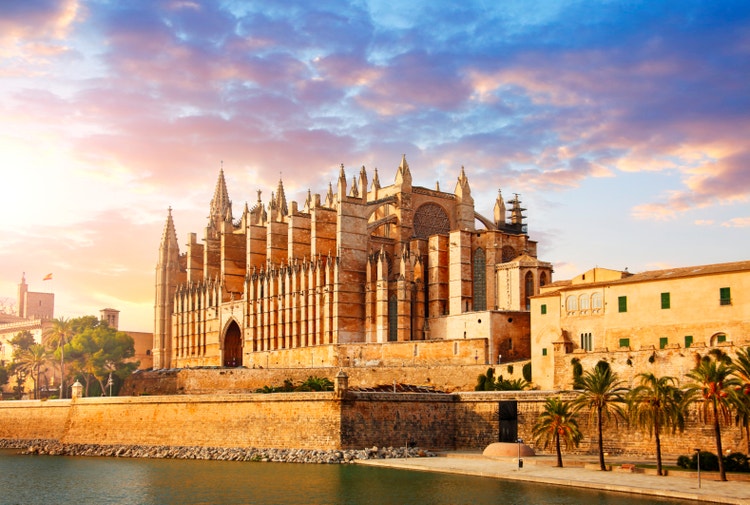
A photograph of La Seu taken from the bay - the great gothic cathedral of Palma de Mallorca detailed by famed Spanish artist Antoni Gaudi
La Seu and the Heart of Palma
It’s difficult to imagine Palma without La Seu. The great Gothic cathedral stands almost directly above the bay, its soaring façade dominating the waterfront. Inside, the scale is just as impressive, with Gothic architecture and details added by Antoni Gaudí. Behind the cathedral, Palma’s historic streets lead past grand townhouses, courtyards, and old stone façades.
There’s more Gothic architecture nearby at La Lonja, the 15th-century exchange built for Palma’s merchants, its soaring stone arches recalling the importance of trade to the city. High above the bay, the circular 14th-century Bellver Castle looks across Palma Bay and the city skyline.
An aerial shot looking over the houses on terraced land in Valldemossa Village near Palma de Mallorca
Valldemossa in the Tramuntana Mountains
High in the Tramuntana mountains, Valldemossa is a village of stone houses, cobbled lanes and old olive groves. Its most famous visitors arrived in the winter of 1838, when composer Frédéric Chopin and writer George Sand stayed here.
Their story is closely tied to the Real Cartuja, the former Carthusian monastery at the heart of the village, where Chopin’s Cell No. 4 preserves the connection. Within the same historic complex, the Palace of King Sancho provides another setting for music, with a short piano performance recalling the composer’s stay.
A photo looking down into a blue clear Lake Martel inside the Caves of Drach in Mallorca
Beneath Mallorca at the Caves of Drach
Mallorca’s countryside is still dotted with traditional windmills, but some of the island’s most extraordinary scenery lies underground. The Caves of Drach extend through vast, cathedral-like chambers where stalactites hang from the ceilings and other limestone formations have developed slowly over thousands of years.
Deep inside lies Lake Martel. Here, classical music carries through the cavern as musicians cross the dark water in illuminated boats, with light reflecting across the lake and surrounding rock. It’s an unusual combination of natural spectacle and live music, all taking place far beneath Mallorca’s surface.
Platters of pastries and treats in a bakery in the "Mercat de l'Olivar" in Palma de Mallorca
Experience Mallorca Through Food and Wine
Palma’s bakeries and markets offer an easy introduction to the island’s food traditions. At Can Joan de S’Aigo, open since 1700, warm ensaïmada is served with thick hot chocolate. Mercat de l’Olivar brings together another part of the city’s food culture, including Es Trenc sea salt, while the local llonguet bread appears in traditional sandwiches served with regional charcuterie.
The countryside tells the story through olive oil and wine. At Finca Treuer, the groves and oil mill show how Mallorca’s olives are cultivated and turned into extra virgin olive oil, paired here with local wine. In the Tramuntana foothills, the route toward Castell d’Alaró passes through a very different landscape before Mallorca’s winemaking traditions take over at Bodegas Ribas.