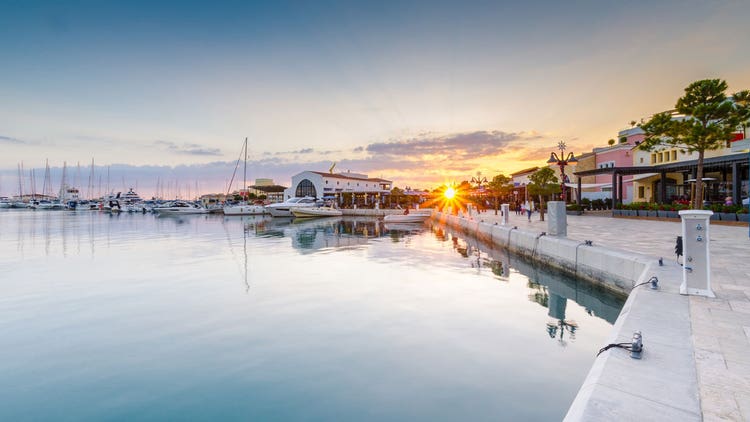
Sunset over Limassol Marina, Cyprus, with yachts and waterfront buildings.
Limassol is Sunny and Sophisticated
Cruises to Limassol
Limassol Cruise Port Highlights
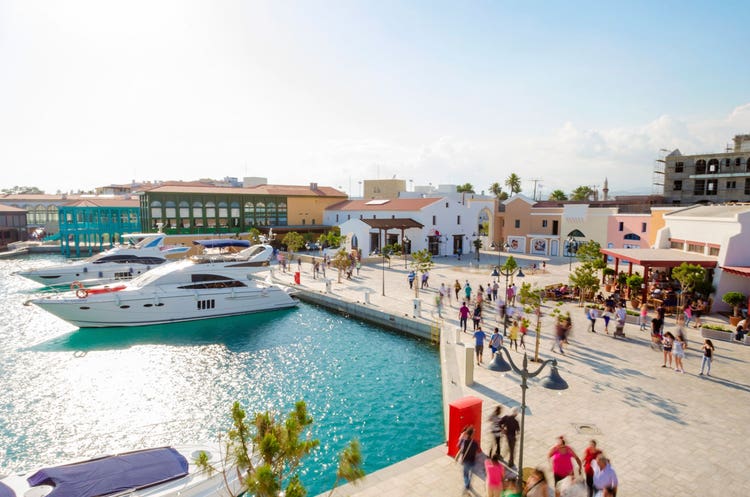
Limassol Marina, Cyprus, with yachts and waterfront buildings.
Historic Center and Limassol Marina
Limassol's medieval castle is traditionally linked to the Lusignan period and is also associated with the marriage of Richard the Lionheart and Berengaria of Navarre. Around it, the pedestrian quarter is packed with restaurants and cafe terraces, from generous Greek Cypriot tavernas known for meze to polished dining at Limassol Marina, Lebanese grills, and contemporary kitchens that draw on the island's culinary heritage. Karatello Tavern, set in a restored carob mill beside the castle, stands out; its Karatello salad combines fried halloumi, tomatoes, pomegranate, and a carob-syrup vinaigrette.
Locals take understandable pride in the city's mix of restaurants, cultural attractions, and historic architecture, yet Limassol is just as much a beach town as it is a heritage destination. The seafront is lined with bars, and the long promenade invites an easy walk beside the water, with plenty of places to stop for a swim. Follow it to the modern Limassol Marina for more restaurants and upscale boutiques, or head a little farther out to beaches such as Lady's Mile and Governor's Beach. History-minded visitors can also make the short trip west to Kolossi Castle, another notable Crusader stronghold near the city.
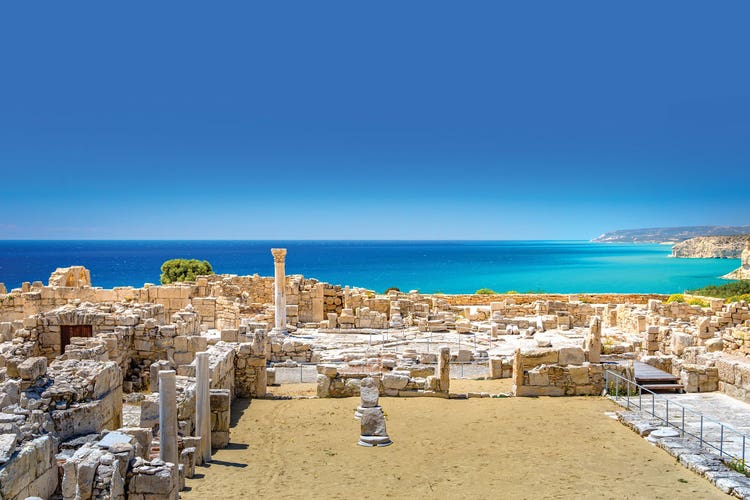
Ancient ruins of Kourion overlooking the Mediterranean Sea in Cyprus.
Kourion
Kourion, or Curium, was one of the great city-kingdoms of ancient Cyprus. A devastating earthquake in the fourth century AD brought about its decline and left behind some of the island's most dramatic ruins, now set on a cliff within the British Sovereign Base Area. The site's Greco-Roman theater, rebuilt in the second century AD and facing the Mediterranean, once hosted theatrical performances as well as spectacles such as gladiatorial contests and hunting games; today, it still serves as an atmospheric open-air venue.
Just east of the theater lies the House of Eustolios, known for its fine fifth-century mosaics. Originally a private residence, it was later adapted into a public bath complex in the early Christian period. Less than three kilometers away is the Sanctuary of Apollo Hylates, one of ancient Cyprus's most important religious sites, while Kourion Beach stretches below the cliffs nearby, combining a visit to the ruins with one of the coast's most striking seaside settings.
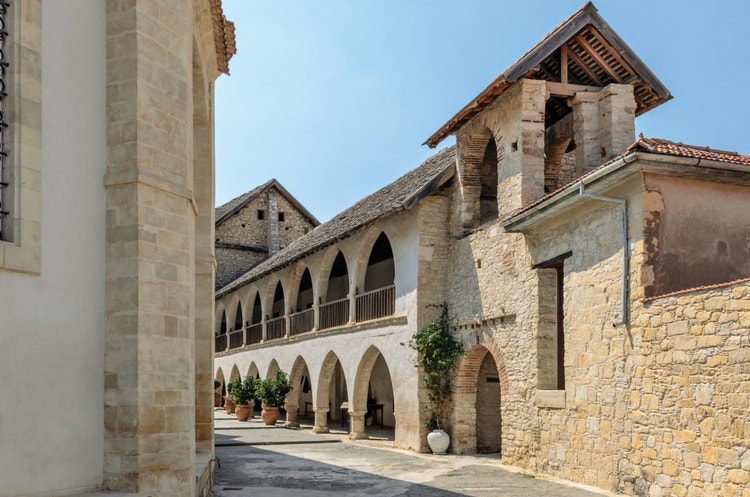
Stone courtyard and arched buildings of the Holy Cross Monastery in Omodos, Cyprus.
Omodos and Troodos
In antiquity, Cyprus's native grapes were harvested and sun-dried to produce what became known as Commandaria, a celebrated sweet wine often described as one of the world's oldest named wines. The name dates to the medieval Commanderie associated with the Knights of St John near Limassol. From the city, one of the loveliest excursions leads into the foothills along the region's wine routes, where Omodos, a handsome wine village of stone houses, quiet lanes, and whitewashed walls, makes an appealing stop.
Beyond the vineyards, the land rises into the Troodos Mountains, where summer temperatures are cooler, Byzantine monasteries and churches dot the landscape, and Cyprus mouflon inhabit the forests. The region's most celebrated religious monuments are the Painted Churches of the Troodos Region, 10 UNESCO World Heritage churches dating from the 11th to the 17th centuries and famed for their Byzantine and post-Byzantine frescoes. Among them, the Solea Valley route includes churches in Nikitari, Galata, and Kakopetria, notably Panagia tis Asinou, Panagia Podithou, and Agios Nikolaos tis Stegis.
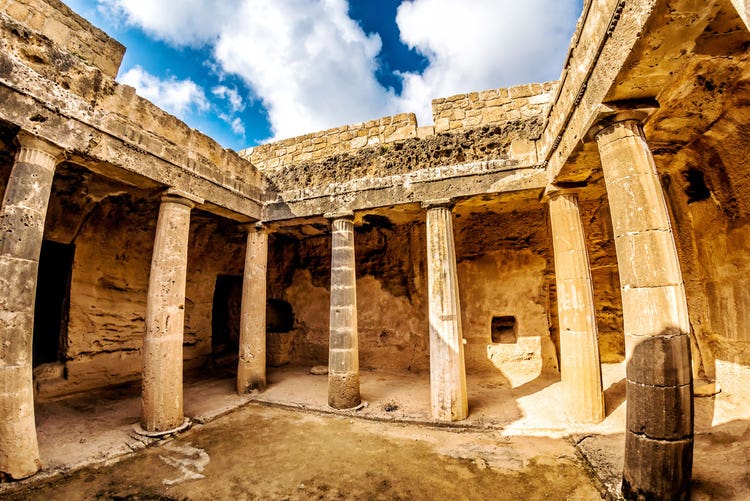
Tombs of the Kings in Pafos, Cyprus
Pafos
Aphrodite's legendary birthplace is an easy excursion from Limassol: follow the coast west to Petra tou Romiou, where, according to myth, the goddess rose from the sea. Nearby at Palaipafos - ancient Old Paphos - stood one of the island's most important sanctuaries of Aphrodite, a center of her cult from the early first millennium BC. Farther along the coast lies Pafos, where tradition links St. Paul with the conversion of the Roman proconsul Sergius Paulus.
In Kato Pafos, the sea meets a lively harbor and broad promenade, watched over by the city's well-known fort. Close by, the House of Aion preserves some of Cyprus's finest fourth-century AD Roman mosaics, part of the UNESCO-listed Archaeological Park of Kato Pafos, where raised walkways make the remains easy to explore. The wider UNESCO-listed site of Paphos also includes the Tombs of the Kings, a monumental rock-cut necropolis dating to the Hellenistic and early Roman periods.